Agency banking software for banks, SACCOs and microfinance institutions
We build the agent app, the POS and USSD menus, and the back office your operations team runs, connected to your core banking system, so an agent in the market can serve your customers the way a branch would.
What changes
- Customers deposit, withdraw and open accounts at an agent near them instead of travelling to a branch.
- Every agent transaction posts to your core banking system with the agent, device and time recorded.
- Your operations team sees float, commission and agent activity in one place.
- Limits and fraud rules are set centrally and apply on every device an agent uses.
What’s included
- Cash-in and cash-out at the agent, posted to the customer's account
- Account opening at the agent, with ID checks and biometric or OTP verification where the device supports it
- Transfers, bill payments, collections, merchant payments and QR payments
- Transfers between bank accounts and mobile money wallets
- Mini statements and balance enquiries, on screen or printed
- Channels for Android POS terminals, an agent app, a web portal and USSD
- Agent onboarding, tiers and transaction limits in the back office
- Float management and commission calculation for each agent
- Agent monitoring and fraud rules, with alerts to your operations team
- Integration with your core banking system through its own interfaces
How it runs
Discovery
We map your products, your agent network plans, your core banking interfaces and the rules your regulator sets for agents, then agree scope and price in writing.
Design
Transactions, limits, commission rules, devices and back-office roles are agreed with your operations, risk and IT teams before we build.
Build and test
We build against a test copy of your core, then test with your teams, including failed postings, reversals, devices that lose signal and agents who run out of float.
Pilot and roll out
A small group of agents goes first. Once your team signs off, the network grows in stages, with runbooks and training for the people who will run it.
A branch where your customers already are
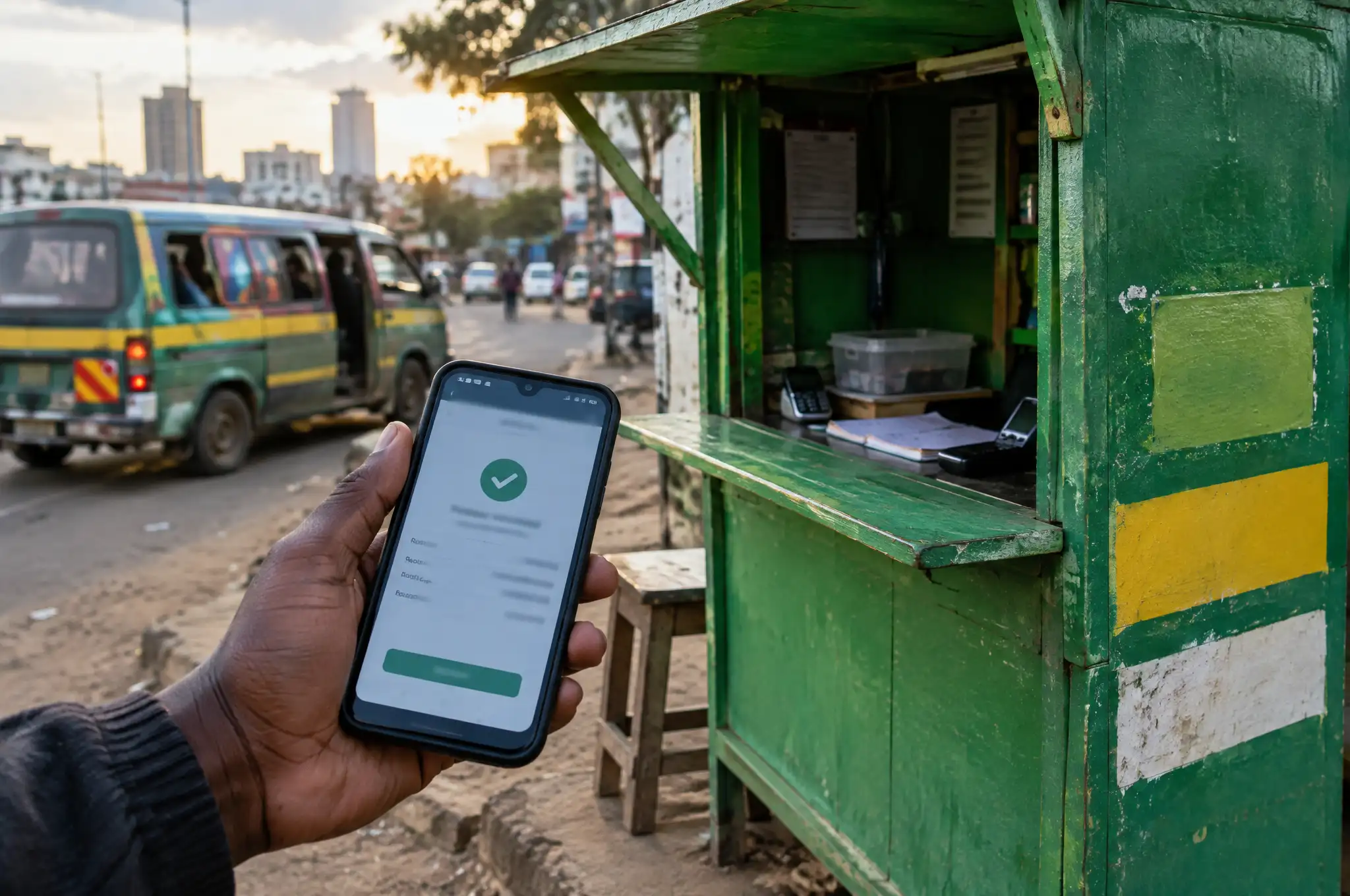
Most of your customers do not live next to a branch. They live next to a shop, a pharmacy or a hardware store. An agent in that shop can take a deposit, pay out a withdrawal or open an account, as long as the system behind them is safe and quick to use at a busy counter.
That system is what we build for your institution: the agent’s device and app, the back office your operations team runs, and the connection to your core banking system.
What an agent can do
Cash in and cash out. The customer deposits or withdraws, the transaction posts to their account, and both receive a confirmation.
Open an account. The agent captures the customer’s details and ID. Where the device supports it, the customer is verified by fingerprint or by a one-time PIN sent to their phone. The application goes to your team for approval if your rules require it.
Pay and collect. Transfers between accounts, bill payments, loan repayments and other collections, merchant payments and QR payments.
Move money to mobile money. Customers send money between their account and their wallet with M-Pesa, Airtel Money, MTN MoMo, Orange Money and other mobile money operators. Transfers to other banks go through banks with open APIs or your switch.
Check a balance. Balance enquiries and mini statements, on screen or printed on the POS slip.
The devices agents already have
Agents work on what suits their business. A busy agent with a counter usually wants an Android POS with a printer and card reader. A smaller one may prefer an app on their own phone. Some work from a computer and use a web portal, and a USSD menu covers agents with a feature phone. The same rules and limits apply on each.
The back office
Your operations team runs the network from one portal:
- Agent onboarding. Applications, KYC documents, approvals and device assignment.
- Tiers and limits. Transaction and daily limits per agent tier, per transaction type and per customer.
- Float. Each agent’s balance, top-ups and rebalancing requests, with a warning before an agent runs out.
- Commission. Calculated per transaction from rules you set, and paid out on your schedule.
- Monitoring. Who is transacting, which devices have gone quiet and which agents need a visit.
Agent fraud needs its own rules
Agency channels have their own fraud patterns: deposits split to stay under a limit, agents using a customer’s details for a transaction the customer never made, and commission earned on money that goes round in a circle. The back office runs rules for patterns like these and alerts your team.
When you need more than rules, agent transactions can feed IntegWatch, our financial crime intelligence product, now onboarding early-access partners, or a monitoring setup we implement for you. See AML & fraud detection.
Start with discovery
Tell us where you want agents and what they should offer first. We reply with the questions that decide scope and cost, then agree a discovery phase with your operations, risk and IT teams.
Common questions
Which devices can our agents use?
Android POS terminals with a printer and card reader, an agent app on an ordinary Android phone, a web portal for agents who work from a computer, and USSD for agents with a feature phone. You choose which channels to offer, and the same limits and rules apply on each.
Does it work with our core banking system?
We connect through the interfaces your core banking system exposes, agreed with your vendor and your IT team. Where the core has no suitable interface, we put an API layer in front of it. We do not modify the core itself.
How do agents move money to and from mobile money?
Through the APIs of M-Pesa, Airtel Money, MTN MoMo, Orange Money and other mobile money operators, under your own agreements with them. Transfers to other banks go through banks with open APIs or your payment switch, and settlement is reconciled against bank statements.
How do you handle agent fraud?
The back office sets limits per agent and per customer, and runs rules for patterns such as split deposits, transactions at unusual hours and agents transacting with their own accounts. For deeper monitoring, agent transactions can feed our transaction monitoring and case management work.
Who owns the platform and the agent network?
You do. The agents contract with your institution, the customer data stays in your systems, and the platform is deployed in your data centre or your own cloud account.
How much does an agency banking platform cost?
It depends on your channels, your transaction types, your core banking system and the size of the network you plan, so we price after a discovery phase. You get a written scope and price before work starts.
Planning a core banking or payments project?
Tell us what you are planning. We scope core banking, payments and identity work with your own IT team, starting with a discovery phase.