Skip to content

Business automation for African organisations, built on the tools you already use

Tell us which work repeats. We design a better workflow, connect your spreadsheets, WhatsApp, mobile money, bank and business software, and keep it running. We use AI only where it is the simplest reliable option.

Where to start

Not sure which fits? Tell us the task and we will suggest the simplest route.

What this practice covers

We start from the task

You describe the work that repeats. We pick the method afterwards, whether that is a rule-based workflow, an integration, a form, a small custom tool or AI.

AI is optional

Many tasks need no AI at all. We use it where it is the simplest reliable option, such as reading free-text messages or documents, and we tell you which approach we chose.

A person approves what matters

Payments, refunds, access changes and anything outside agreed limits wait for a named person to approve. Every action is logged, so you can see what ran and when.

Works with what you have

Spreadsheets, WhatsApp, email, mobile money, bank statements, accounting software, Odoo and other ERPs, CRMs and custom systems. We connect what you already use before suggesting anything new.

We keep it running

After go-live we can monitor each automation, fix what breaks, report what it handled and improve it every month. You keep ownership of your data and accounts.
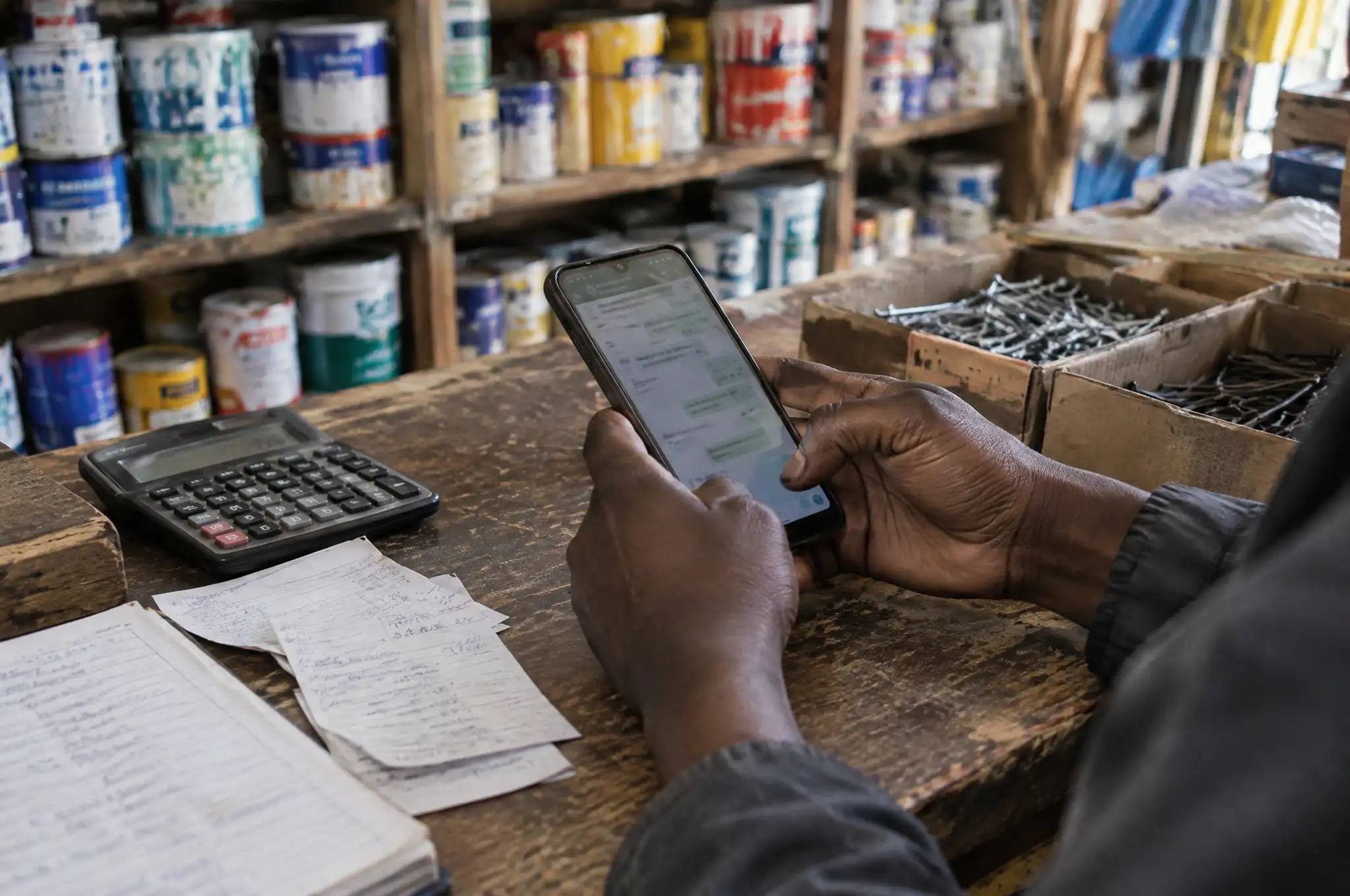
A shopkeeper’s hands hold a phone over a hardware-shop counter, beside a calculator and handwritten receipts

Services in this practice

Work that repeats, handled once

Most businesses lose hours each week to the same steps. Someone retypes WhatsApp orders into a spreadsheet, checks M-Pesa and bank statements against invoices, or chases a manager for a signature. Someone else builds the same report every Monday. None of this needs a person’s judgment every time, and all of it can go wrong when people are busy.

Business automation takes those routine steps and runs them on their own, with your team watching the exceptions. If there is a repetitive process in your business, let’s explore whether it can be automated.

What we automate

  • Customer questions. Routine replies on WhatsApp, email and web chat, with unusual cases passed to a person. See WhatsApp AI agents.
  • Sales, orders and stock. Enquiries logged, draft quotes prepared, orders captured once and checked against stock.
  • Payments and collections. M-Pesa and other mobile money, bank statements and open bank APIs matched to invoices, with reminders on your schedule. See back-office automation.
  • Documents and approvals. Details read from invoices and forms, requests routed to the right approver, and a record kept of each decision.
  • Field teams, HR and bookings. Job assignments, leave requests and appointment reminders that move without anyone chasing.
  • Reports. Figures gathered from the systems you approve, sent on schedule, with alerts when something crosses a line you set.
  • Phone calls. Reception, reminders and routine follow-up calls, built for each client. See AI call agents.
  • A whole small business. Accounting, stock, sales and payroll in one system. See business automation for SMEs.

We are not tied to one technology

We start with the business problem and then choose the tools. A client may run on spreadsheets and WhatsApp, an ERP such as Odoo, an accounting package, a POS, a CRM, a hospital or school system, custom software, or nothing formal yet. Each of those is a valid starting point.

The fix might be a rule-based workflow, a connection between two systems, document processing, a scheduled report, a small custom tool, or an AI assistant. Often it is a mix. We recommend the simplest option that will still be reliable in a year.

When we use AI, and when we don’t

AI is useful when the input is messy: a customer’s free-text message, a scanned delivery note, a question asked in English, Swahili or both. It is the wrong tool when a clear rule will do, such as “send a reminder seven days after the due date”.

Where we use AI, it works inside limits you agree. It uses only the data the task needs, it cannot act outside the permissions you set, and its answers are checked against your own records. For the packaged version, see AI Digital Employees.

People stay in charge

Automation should never take a decision your business has not agreed to hand over. For anything consequential, such as paying money out, issuing a refund, changing someone’s access or writing off a balance, we build in the right approvals:

  • Permissions. Each automation can see and change only what its task needs.
  • Approvals. Actions outside agreed limits wait for a named person.
  • Audit trail. Every message, action and approval is recorded with a time and a name.
  • An off switch. You can pause any automation at any time.

Your staff stop retyping and checking. They spend that time on customers, exceptions and decisions.

After go-live, we keep it running

An automation is only useful if it still works next quarter. Your bank changes a statement format, a supplier changes an invoice layout, or your team adds a new product line. On a managed plan we:

  • monitor each automation and fix failures
  • report what it handled and what it passed to your team
  • adjust it when your other systems change
  • improve it each month, and add new workflows when you are ready

You can also run it yourself with our documentation and training. Either way, your data, accounts and WhatsApp number stay yours.

Before and after

Illustrative examples, not client results.

  • Wholesaler, Eastleigh, Nairobi. Before: Retailers send orders on WhatsApp all day. Two clerks retype them into a spreadsheet each evening, and some get missed. After: Each WhatsApp order is captured and checked against stock as it arrives. The clerks review a short list of unclear orders instead of retyping everything.
  • Clinic, Kisumu. Before: Patients forget follow-up visits, and the front desk spends its mornings phoning to confirm appointments. After: Patients get a booking confirmation and a reminder the day before. The front desk calls only the patients who ask to reschedule.
  • Private school, Nakuru. Before: The bursar matches fees paid by M-Pesa, Airtel Money and bank to pupils by hand, then writes arrears letters one by one. After: Payments are matched to pupils automatically and unclear ones go to one list. Parents in arrears get a polite reminder on dates the bursar sets.
  • Property manager, Kilimani, Nairobi. Before: Rent arrives by mobile money and bank transfer with vague references, and repair requests come by phone and are never logged. After: Rent is matched to units and receipts go out. Repair requests become tracked jobs that the caretaker updates from a phone.
  • Transport company, Machakos. Before: Drivers send trip updates as voice notes, and the office rebuilds each day’s delivery status from several group chats. After: Drivers tap a status update at each stop. Customers get delivery confirmations, and late trips are flagged to the dispatcher.
  • Safari operator, Arusha, Tanzania. Before: Enquiries from agents and travellers arrive by email and WhatsApp across time zones, and each quote takes days to prepare. After: Enquiries are logged with dates and group size, and a draft quote is prepared from current rates. A consultant checks it before it goes out.
  • Cleaning company, Kampala, Uganda. Before: Supervisors assign jobs by phone, and invoices go out late because the office cannot tell which jobs were finished. After: Confirmed bookings become jobs with a checklist. When the crew marks a job done, the invoice is ready for the office to send.
  • Construction contractor, Eldoret. Before: Site requests for materials come by phone and on paper, approvals wait on one director, and costs are tallied at month end. After: Material requests are logged from site and routed to the right approver. Costs per project update as purchases are approved.
  • NGO, Lodwar, Turkana. Before: Field officers collect beneficiary data on paper, and staff in Nairobi retype it before any donor report can be written. After: Officers capture data on a phone form that works offline. Records sync when there is signal, and donor reports draw on one clean list.
  • Accounting firm, Westlands, Nairobi. Before: Staff chase clients for the same documents every month and track deadlines in a shared spreadsheet that is often out of date. After: Clients get document requests and reminders automatically. Partners can see which files are complete and which deadlines are close.
  • SACCO, Meru. Before: Loan applications arrive on paper at branches, and staff phone each guarantor to confirm, one call at a time. After: Members apply through a simple form, and guarantors confirm by SMS or WhatsApp. Credit officers review complete files only.
  • Importer, Mombasa. Before: Shipping documents, customs entries and supplier invoices sit in email threads. Nobody can quickly say where a shipment is. After: Documents are read and filed against each shipment, and key dates are tracked. The team gets an alert when a step is overdue.

The tools we connect

These are examples, not a limit. If your business runs on it, we can usually connect to it or work around it.

  • Conversations. WhatsApp (including the official WhatsApp Business Platform), email, SMS, website chat and forms.
  • Everyday office tools. Excel and Google Sheets, Google Workspace and Microsoft 365, shared drives and scanned documents.
  • Payments and banking. M-Pesa, Airtel Money, MTN MoMo and other mobile money, bank statements, banks with open APIs, payment gateways.
  • Business systems. Odoo and other ERPs, QuickBooks, Sage and similar accounting tools, CRMs, POS systems, HR and payroll software, booking and records systems used by clinics, schools and hotels.
  • Tax and government. KRA eTIMS.
  • Your own software. Custom systems and databases, and older systems with no API, handled with file transfers or careful screen automation where that is the only option.

Naming a tool here does not mean we are its official partner. We connect to it through the access you already have.

How we work together

  • Automation assessment. We look at one area of your business with the people who do the work. You get a plain-language map of the tasks worth automating, the order to do them in, and what each needs from your systems. The first call is free.
  • Project delivery. A fixed scope agreed in writing, built in short steps, tested on a safe copy of your data and switched on with your team. You get documentation and training so you can run it yourselves.
  • Managed operations. For workflows that matter every day. We monitor runs and handle failures. We also report what each automation handled, keep it working when your other systems change, and tune it every month.
  • Support retainer. A set amount of time each month from a team that already knows your setup. Use it for new automations, small changes, staff questions or reviews before a busy season.

Larger or regulated projects

If you are a bank, SACCO, fintech or large organisation connecting core systems or partner APIs, start at enterprise technology. For ERP work specifically, see Odoo ERP and KRA eTIMS compliance.

What could a digital employee take off your team?

Pick a role, then put in your own salary and headcount. You get an estimate of the staff hours freed, with every assumption listed underneath.

The role

The kind of work you want a digital employee to take on.

Gross pay per person in this role, in Kenyan shillings.

How many people do this work today, from 1 to 500.

Time spent on work that follows the same steps each time. Choosing a role sets a typical starting point you can change.

Your estimate

Per month

Estimated: 106 staff hours freed per month. KES 27,000 is the salary value of that time, not cash saved.

A rough estimate, not a quote. It updates as you change it, and nothing you enter leaves this page.

Book a digital-employee pilot

Assumptions

  1. A working month is 176 hours per person.
  2. A digital employee can take on about 60% of the repetitive share of a role.
  3. The freed time is valued at the average monthly salary spread over 176 hours.
  4. This is an estimate, not a quote. Your real figure depends on the work and is confirmed in a pilot.

What is taking too much time in your business?

Tell us about one task. We reply within one working day and suggest the simplest way to handle it.